








 AND WE HAVE LOST THE FAITH OF THE DAISIES
What shall I make of this dark in the hope?”
- From “Funeral in the Woods”
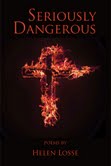
North Carolina poet Helen Losse is well steeped in the American tradition of plainsong so it may shock readers familiar with her style (or that of plainsong poetry or other Main St. Rag authors) to see a burning cross depicted beneath the title of her new collection of poems Seriously Dangerous.
But Losse is no Klansman, or Klanswoman; she is not initiating a rallying cry on behalf of any political scene or in general. Her rhetoric has the honest knack for the odd and frequently humorous image which is always strategic, poetic, and also quite slyly placed within her narratives:
“People with crosses have
various purposes.
We know most are dangerous,
except for the chosen few
God actually likes.
I think not. But what do I know?
I’m just an old soul
wearing nerdy glasses.
Aren’t most of us rather
forgettable in the long run?
And maybe if the long run is
not-so-long.
The earth spins, yes?
Spin, spin, spin,
and we have lost the faith of the daisies.”
From “Spin, Spin, Spin’
Seriously dangerous images, scenes and ideas are the unifying thread between most of the poems in this book. The excerpt above demonstrates how Losse’s poems aren’t literally dangerous, in the “Burn Baby Burn” sense of danger, but are instead flirting with perceived danger, at times coy and playful, not seeming serious, but then suggesting at just the last moment that we are in fact, always in danger, all the time, whether we like it or not. There is something suggested that the strength we build inside ourselves is based on how well we cope with that fundamental fact of life.This is not to say that there isn’t an awareness of the political in the work. Issues of race, war and degradation are deftly handled, but without fetishizing buzzwords or tragedy or even history. It is in this context that the plainsong style works to the advantage of these poems, when they could go off on political or polemic tangents, the rootedness in the Earth, and in Earth language restrains those kind of poetic temptations. And while the poems often seem religious, or Pacifist-Christian in tone, there are also in fact many images of raw nature, particular light and color, which hint at a pagan sensibility balancing out the spiritual reflections that are both conflicted and processing within these stanzas:
“Hymns from a church. Bells that always ring
at dusk. The time of year when night comes early.
The setting sun behind ever-green trees,
A forlorn sky becoming heavy blue. The horizon
as it turns pink and mauve, then purple.
It would be easier to speak as others believe,
not to feel the ocean’s intentions nor to sense
the pull of the moon. Grace abounds in ocean,
in flotsam, in rich sea foam, floats in earth’s
swirling dust, though only in teaspoonfuls.
The cold wind scatters leftover leaves,
while Daddy’s silhouette plays
a mean harmonica. Timid at first, I dance –
which is only to say, that which I love
often comes from memories.”
no drawn way. Above me,
the ceiling is murky gray.
Soft moonlight filters throughan open window. A pattern begins.
I recognize it from the other nights.
A quarter moon. I get into
a gondola with a man I’ve
never seen. The man becomes
the moon, the ocean the sky.
The gondola floats among
cirrus clouds, in and out of soft rain.
Then the rain becomes hard,
hits window glass. The man is
gone, & I am not in the boat.
There is only the ceiling above me,
familiar like the sky.